
Busy parents
No time to sit with them every evening
AskCrates picks up where they left off, every day until the test, and asks the questions you would ask. You get your evening back — and a quick look at how far they’ve come.


It’s 8 pm, the test is on Thursday, and you’re still at work.

Every day until the test, AskCrates works through your child’s own school notes with them — patiently, one question at a time, in the language they understand best. And you see when they’ve got it.
See it work
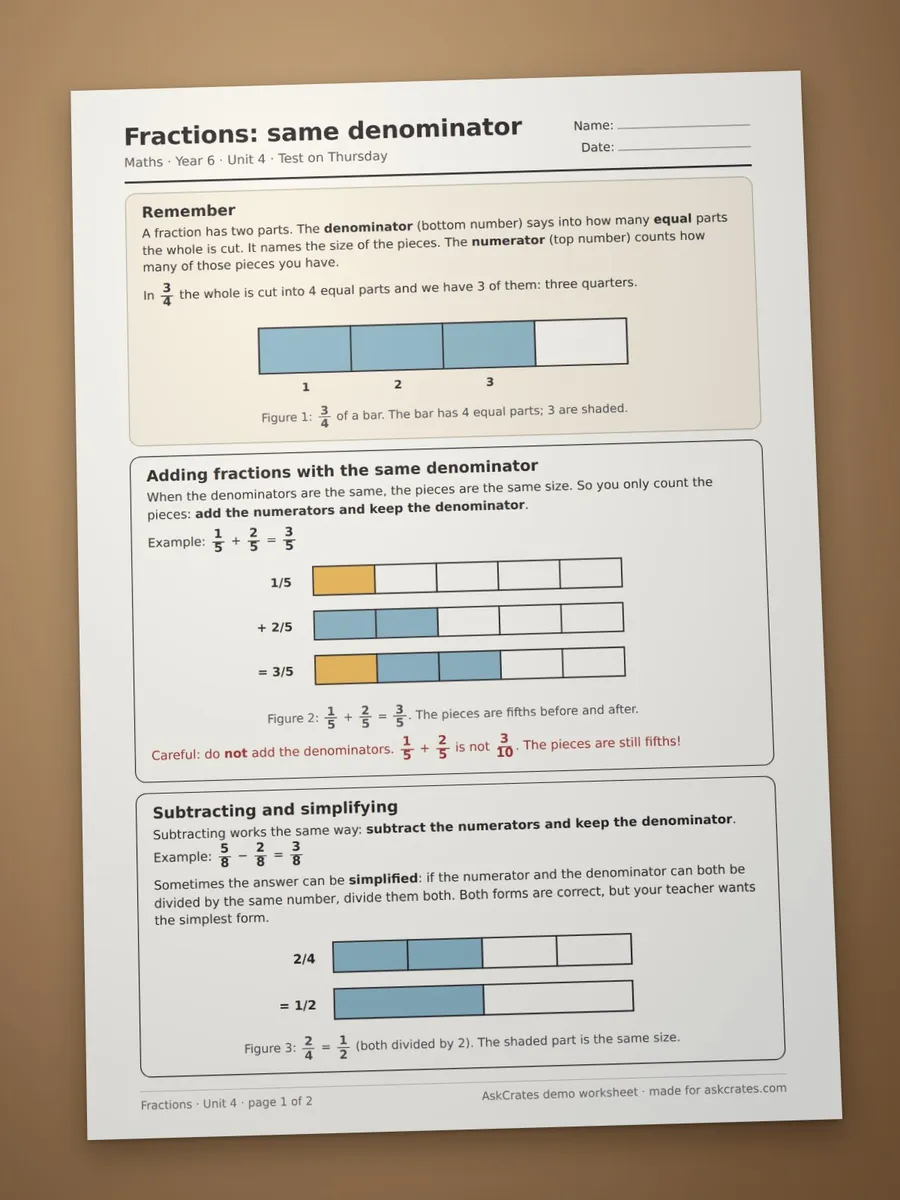
Two real lessons AskCrates gave on the same sample worksheet: once on the English sheet, once on the German one, for a child who studies in English.
Fractions test · Test on Thursday · 20 min a day
Explain what the numerator and the denominator of a fraction mean
Plan ready · 6 objectives
Excerpt from a sample lesson on a sample worksheet. The student is simulated; the plan, the questions and the feedback are AskCrates’ own output.
Explain what the numerator and the denominator of a fraction mean
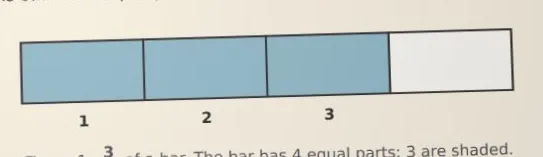
Tutor: That's it: 8 on the bottom for the slices in the whole pizza, 3 on top for the slices you ate. So the fraction is 3/8. Now let's look at a bar cut into equal parts, where you read the fraction from a picture. Figure from the worksheet: a bar divided into 4 equal parts, 3 of them shaded. How many equal parts does this bar have, how many are shaded, and what fraction does that make?
Student: the bar has 4 parts and 3 are shaded so its 4/3
Tutor: You read the picture correctly: 4 equal parts and 3 of them shaded. Only the order is flipped. The number of parts in the whole goes on the bottom, and the shaded parts you have go on top. Using that, which of the two numbers, 3 or 4, is the numerator here, and what is the fraction written in the right order?
Student: 3 is the numerator and its 3/4
Tutor: Yes: 3 is the numerator because it counts the shaded parts you have, and 3/4 has the 4 equal parts of the whole on the bottom. You also fixed the order yourself, which was the tricky bit earlier.
On your Family page: Noah: done for today · 1 of 6 objectives demonstrated
Who it’s for
Most parents want to help — and most can’t, every evening: work, other children, a school language they never learned, a method they were never taught. AskCrates takes on the explaining and the practising, and leaves you the part only you can do.
Busy parents
AskCrates picks up where they left off, every day until the test, and asks the questions you would ask. You get your evening back — and a quick look at how far they’ve come.

Expat and international families
Your child studies the school’s own pages, with explanations in the language they think in. Finally there’s someone who can help with the homework you can’t read. See it below.

Parents who can’t help with the subject
No more arguing about methods at the kitchen table: AskCrates teaches from the pages the teacher handed out — the teacher’s way, explained patiently.

Catching up
Upload what they missed and set the test date. AskCrates works on it a little every day — and tells you honestly if the time is too short.

Teenagers
They study on their own device with their own PIN. You don’t have to nag — and you can still look in whenever you like.

Families with several children
Each child gets their own patient tutor and plan, all on one family subscription.

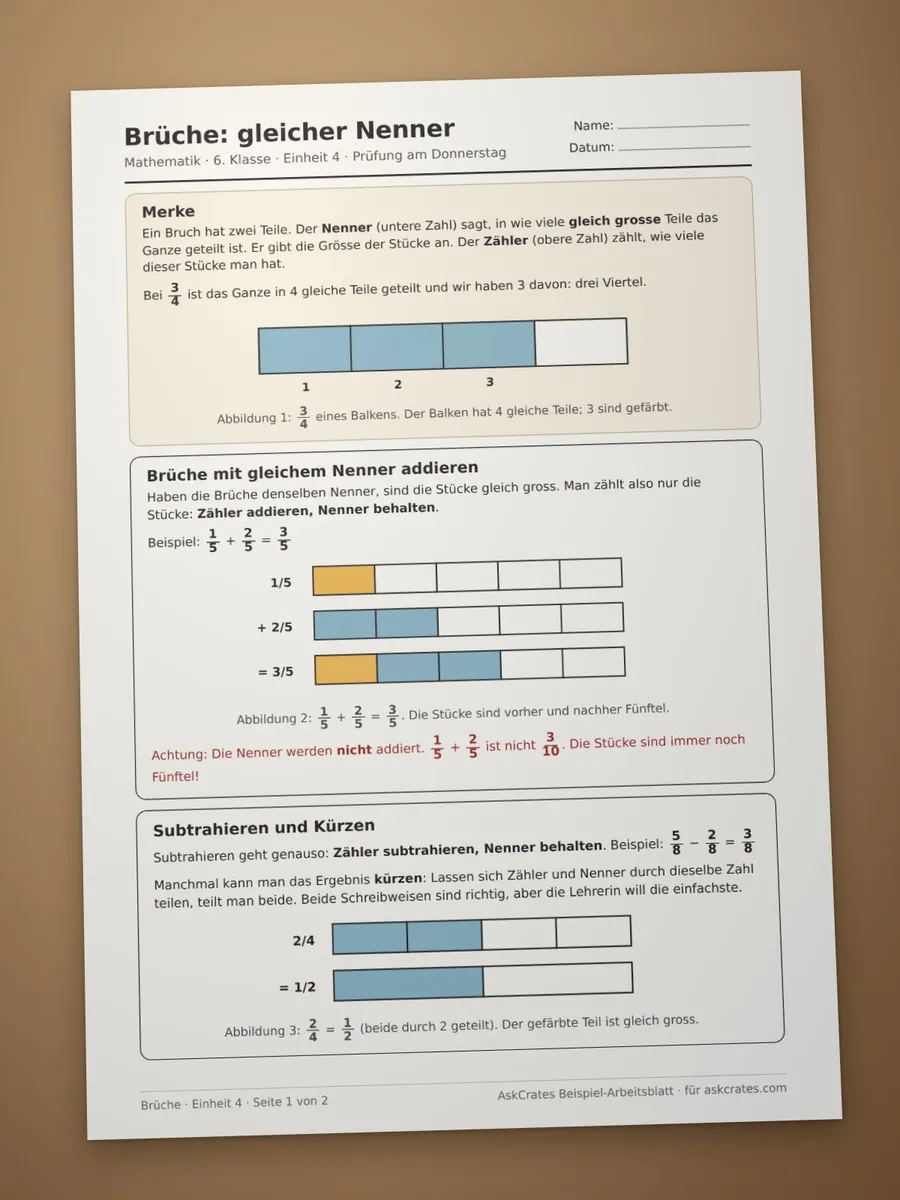
Upload the school’s material in German, French, Italian or any other language. Your child chooses the language of the explanations — English, German, French, Italian, Spanish, Portuguese, Turkish, Polish, Ukrainian or Arabic — and the tutor teaches the pages the teacher handed out. Below: a worksheet in German, a child whose app is in English.
Worksheet in German
Plan, in the worksheet’s language
Lesson, in English (the child’s language)
Hi! Let's start with what a fraction is made of. Take 3/4: the bottom number is the Nenner (denominator), and it tells you into how many equal pieces the whole is cut. So in 3/4, the whole is cut into 4 equal pieces, and that also tells you how big each piece is. Here's a small case: a chocolate bar is cut into 8 equal pieces, and you look at the fraction 5/8. Which number tells you how many pieces the bar was cut into, and what is it?
the 8. it says the bar is cut into 8 pieces
Yes, the 8 is the Nenner, and it tells you how many equal pieces the bar has. Now the top number, the Zähler: it counts how many of those pieces you have. In 5/8 you have 5 of the 8 pieces. Try this one: a pizza is cut into 6 equal slices and you eat 4 of them. Which fraction is that, and which number is the Zähler?
Safe by design
You create your child’s account, you decide what the tutor may use, and every conversation is there for you to read. AskCrates guides your child to the answer; it doesn’t hand it over.
Create child accounts with their own PIN, decide per child whether uploads are allowed and whether the AI may use general knowledge or only your materials, and see each child's day, week and exam progress at a glance.
Uploads power your learning only. We do not use your content to train our or any third-party AI models. Originals are deleted after processing.
Parents can view as their child and read the tutor conversations. Learners can see — and change or remove — what the tutor remembers about how they learn best.

What you see as a parent
View as childNoah
Family · Fractions test
Progress1 of 6 objectives demonstrated
Tutor conversation
3 is the numerator and its 3/4
Yes: 3 is the numerator because it counts the shaded parts you have, and 3/4 has the 4 equal parts of the whole on the bottom. You also fixed the order yourself, which was the tricky bit earlier.
From sign-up to test day
Your child’s own pages become a daily plan, a tutor that asks, and a mock exam — without you having to sit beside them.
Photograph a worksheet or upload a PDF or Word file. Figures and diagrams are found too, and the originals are deleted after processing.
AskCrates splits the material into objectives and a daily plan up to the test date. Each day the tutor teaches from your child’s own pages, in their language, and asks instead of telling. An objective only counts once every key point has been answered without help.
The plan made from it
Fractions test · 6 objectives
01Explain what the numerator and the denominator of a fraction mean
Key points of the first objective
02Add fractions with the same denominator
03Subtract fractions with the same denominator
04Simplify a fraction to its simplest form
05Solve word problems with fractions of a whole and give the answer in simplest form
06Find and correct the mistake of adding denominators
Questions on every objective, with no hints. You see the score and the right answers, and the weekly summary tells you where to help.
Mock exam, graded
5 of 6 correct
Why AskCrates?
A child asks for the answer to a homework question. This is what a general AI chatbot replied, and what AskCrates replied.
Typed by the child
whats the answer to number 5? mia eats 2/8 of the pizza and her brother eats 3/8. how much did they eat together and how much is left
Gives the finished answer. Nothing is left for the child to work out.
Eaten together: 2/8 + 3/8 = 5/8 of the pizza Left over: 8/8 − 5/8 = 3/8 of the pizza Since the denominators are the same, you just add the numerators (2 + 3) and keep the denominator at 8. The whole pizza is 8/8, so subtracting what they ate leaves 3/8.
Works the first step through, then hands the next one back to the child.
Together they ate 2/8 + 3/8 = 5/8 of the pizza: the tops add to 5 and the slices stay eighths. For the part that is left, it helps to know that the whole pizza is 8/8, and you take away what was eaten. So what is 8/8 − 5/8, and can it be simplified?
Both replies come from one test run and are unedited, except that maths notation is shown as plain fractions. The chatbot got the question with no other instructions.
Pricing
Study plans, Socratic tutoring and mock exams from your materials — parents in control. For children aged 7–17. Start with a 1-month trial: card required, nothing charged until it ends.
0 CHF for the first month
Try the whole app with one child.
During the trial: 1 child, 1 subject with 1 topic, 1 active plan, 1 mock exam per plan and up to 125 tutor messages a day.
12.90 CHF/month
After the trial — for families with several exams on the go.
Starts automatically when the trial ends — or start it early inside the app.
Your subjects, plans and progress stay when the trial turns into your subscription.
Prices are shown in CHF. At checkout you’ll see the price in your local currency, with any applicable taxes.

Start with one worksheet and the test date. 0 CHF for the first month: card required, charged only after, cancel in Settings.
Quick answers about AskCrates.
Yes. Parents create child accounts, set each child's PIN, and decide per child whether uploads are allowed and whether the AI may use general knowledge or only your materials. Every tutor conversation belongs to a learning plan built from your materials, and parents can view as their child to see how it's going.
For children and teenagers aged 7–17, with a parent or guardian holding the family account. Adults who study for an exam themselves create a family account and add themselves as the learner.
Setting up is a one-off: add your child, upload the material and set the test date. After that your child works through the daily plan on their own device. You see progress on your Family page and in a weekly email, and you can read any conversation whenever you like.
Yes. Upload the school’s own material in its language. The plan follows that language, and each child chooses the language their tutor explains in: English, German, French, Italian, Spanish, Portuguese, Turkish, Polish, Ukrainian or Arabic. You decide per child whether the tutor may use only the uploaded material or general knowledge too.
A phone, tablet or computer with a browser. Children sign in on their own device with your family code and their own PIN, no email needed. Worksheets can be photographed with the phone camera.
Any subject you add materials for: maths, languages, science, history, and more. The tutor adapts how it teaches — step-by-step reasoning for maths and sciences, active practice for languages, structured understanding for knowledge subjects. For maths, it can also set practice exercises whose answers are checked automatically.
Most AI apps hand you the answer from generic internet knowledge. AskCrates teaches from your uploaded materials, asks you to recall, apply and explain, and only counts an objective as demonstrated once you've shown it on your own — then checks you're ready with mock exams.
Each plan comes with mock exams: a written exam across every objective, graded with no hints, with a score and review afterwards. Progress then shows for each exam how many days are left, which objectives your child has demonstrated or mastered, the latest mock exam score and what needs attention.
Every family starts with a 1-month trial: the whole app with one child, one subject, one topic and one active learning plan, including one mock exam. After that, Pro costs 12.90 CHF a month or 129.90 CHF a year and unlocks unlimited subjects, topics, plans, tutor messages (fair use) and mock exams, with 3 children included. Families with more children can switch to a 4-child (15.90 CHF / month) or 5-child (18.90 CHF / month) plan inside the app.
The trial turns into your subscription when it ends, so the payment method is added at the start — it is also how we know an adult holds the account. Nothing is charged during the trial; we email you 7 days before it ends, and you can cancel in Settings at any time before then. If an account then stays without a subscription, everything is kept for 6 months; after that we delete it, with an email 30 days before.
The trial starts at once and nothing is charged. You add your child under Family, create a subject and a topic, upload a worksheet or PDF and set the test date. The plan is usually ready within a minute, and today’s lesson opens right after. Have a worksheet or PDF at hand when you start.
No. Your uploaded materials are used only to power your own learning experience. We do not use your content to train or improve our or any third-party AI models.
Originals are deleted after processing. Only the extracted content needed for learning remains, until you delete its topic or subject, or your account — which you can do yourself in the app at any time.
The app is available in English, German, French, Italian, Spanish, Portuguese, Turkish, Polish, Ukrainian and Arabic, and each child can have their own language. You can upload materials in any language — the tutor teaches in the language you choose. That's especially helpful for expat families when school notes and home language differ.